Virtual Staging vs Real Staging: Cost, Speed and Fit
Virtual staging vs real staging compared on cost, turnaround, buyer appeal and limits, with a table and a verdict for each listing type.
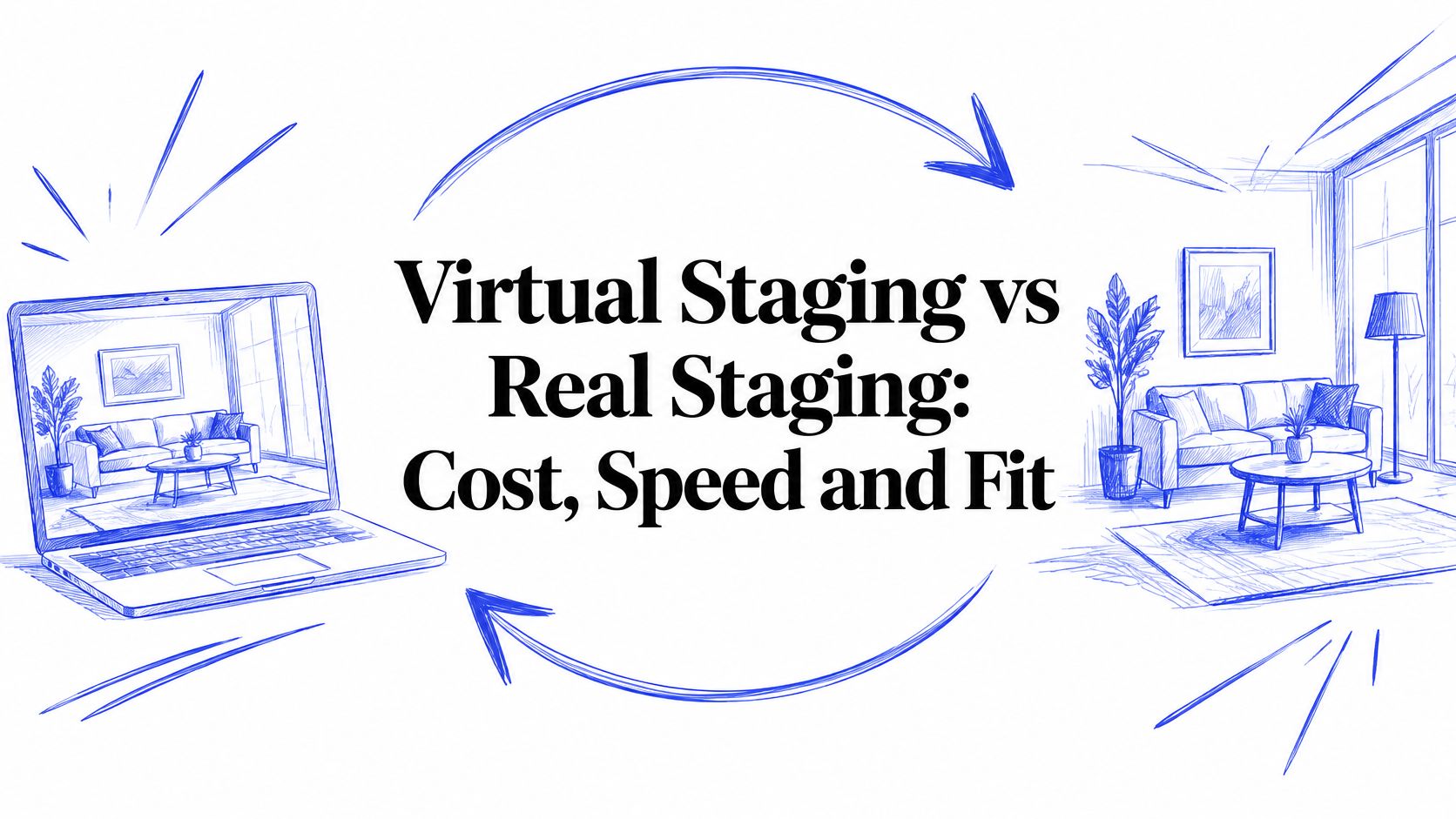
The most popular advice about virtual staging vs real staging is to choose the cheaper option because both help buyers imagine living in a home. That treats a furnished photograph and a furnished property as interchangeable. They aren't.
The better question is what uncertainty must the buyer resolve? If an empty room looks unfinished online, digital furniture may be enough. If buyers need proof that a sofa fits, a walkway stays clear, or expensive finishes justify the asking price, the decision requires more than an attractive image. Disclosure matters too, because a convincing visualization is only useful marketing when buyers understand what's real.
Virtual and Physical Staging at a Glance
Buyers can struggle to interpret an empty or dated room. Both staging methods address that difficulty, but they work in different places: virtual staging changes the photograph; physical staging changes the viewing environment.
Our Virtual Staging tool furnishes and stages a photo of an empty room, keeping the walls and windows where they are. Physical staging places actual furniture and decor inside the property, which can then be photographed and experienced during showings.
Virtual vs physical staging on the factors that decide the choice
| Factor | Virtual staging | Physical staging |
|---|---|---|
| Upfront cost | Per image or per room, without furniture delivery or storage | Professional-service or agent-led expenditure, plus the agreed furnishing scope |
| Turnaround | Digital production and approval, with delivery confirmed in writing | Several days across delivery, installation, removal and storage arrangements |
| Changes to the property | None; only the listing photo is edited | Furniture and decor physically placed in the home |
| What buyers see in person | The current room, unchanged | A furnished room with actual furniture scale and lighting |
| Sale-impact evidence | No independent study isolates its effect | Agent-reported staging outcomes, not controlled trials |
| Best fit | Vacant rooms, tight budgets and quick visual tests | Homes where scale, texture or occupied-room context matters |
| Disclosure risk | Labels and original-image records require active management | Lower image-to-room mismatch when photographed accurately |
The rows that matter most
Cost and turnaround attract attention first. Virtual staging avoids moving inventory, while physical staging requires access and scheduling. But the evidence and disclosure differences are not matters of degree: one method presents a proposal for furnishing, while the other lets buyers inspect that arrangement.
For a seller-facing explanation of the digital workflow, Edinhart Realty and Property Management's guide to selling your home with digital staging is a useful starting point.
Choose on the basis of the buyer's unresolved question, not the most polished sample image. Virtual staging offers a lower-logistics route to furnished marketing images. Physical staging remains the reference point when the room itself must demonstrate how living there would work.
What Each Option Costs and How Long It Takes
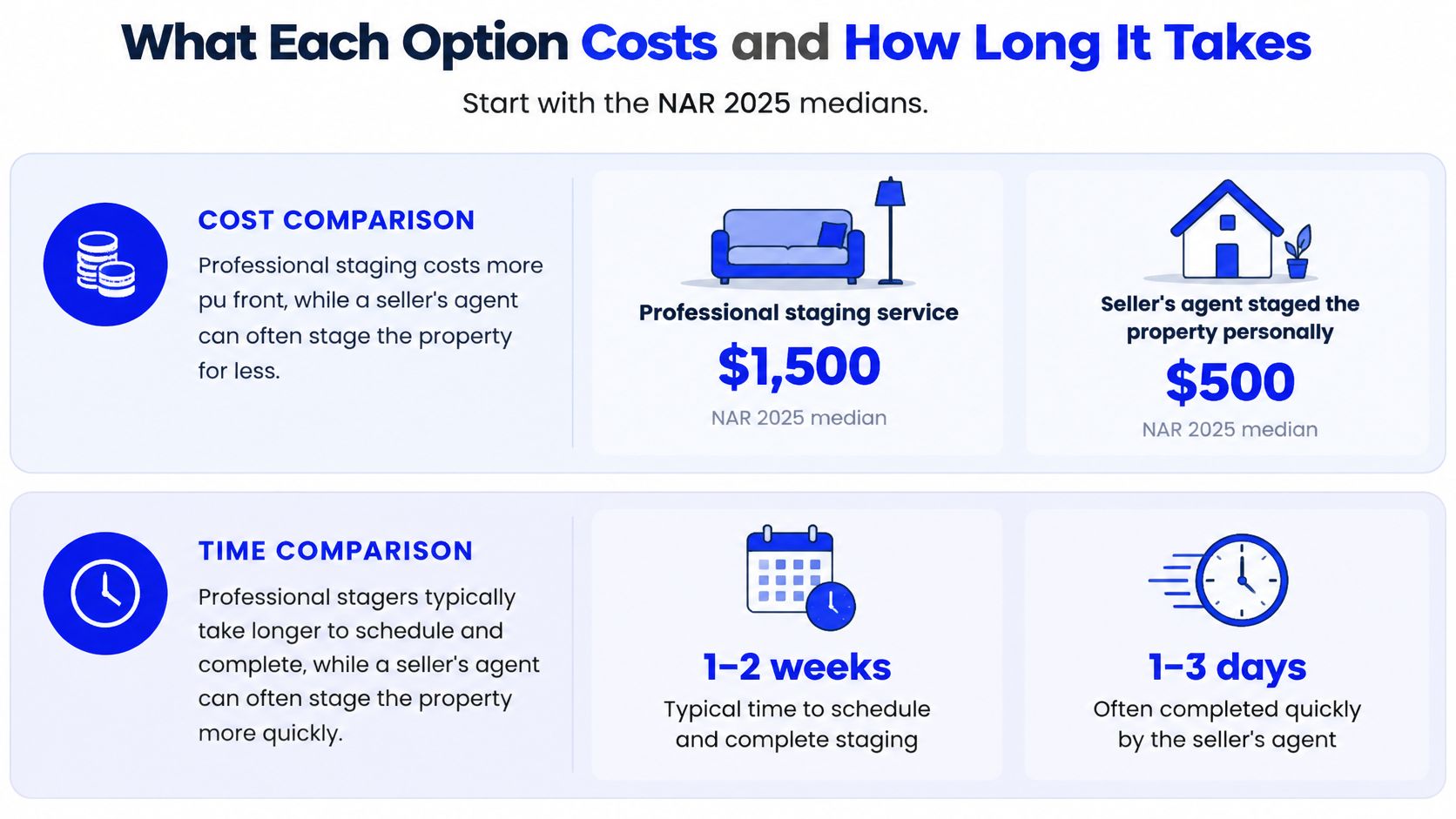
The NAR 2025 Profile of Home Staging reports median expenditure of $1,500 when sellers used a professional staging service, compared with $500 when the seller's agent personally staged the property. These are agent-reported spending figures for staging generally, not a virtual-staging price comparison or a quote for furnishing your home.
Compare completed work, not advertised entry prices
A physical-staging quotation should identify consultation, furniture selection, delivery, installation, rental duration, removal and any storage charges. Property access also belongs in the budget: someone must coordinate entry, protect finishes and accommodate the installation schedule.
Digital services may charge per image or per room, while software subscriptions use credits. Our Lite plan costs $29 per month, billed monthly, and includes 1,000 credits per month. That's a software allowance, not a promise of a particular number of approved listing photographs.
Consider a hypothetical vacant listing requiring furnished images of the living room and bedrooms. The digital calculation is:
Digital production cost = selected rooms × quoted room rate + extra views + chargeable revisions.
A physical proposal may combine those rooms into a single delivery, then add rental extensions and eventual collection. Don't assume that multiplying an individual room price reproduces the physical package cost.
The comparison changes when you request additional camera angles or repeatedly replace furniture styles. Digital production has no delivery charge, but revisions still consume paid work or credits. Conversely, an installed furniture arrangement can appear in multiple photographs without being restaged for each view.
Put approval time into the schedule
There isn't a reliable universal delivery benchmark for virtual staging in the cited evidence. Get the turnaround commitment in writing, including when the clock starts and whether it covers revisions.
A render-time planning guide can help you distinguish image generation from the broader production schedule. For listing purposes, the relevant endpoint is an approved, checked and correctly labeled image, not the first generated result.
Compare proposals using the same checklist:
- Approved-image price: Include required views, output quality and any minimum order.
- Revision allowance: Establish what counts as a correction versus a new design.
- Delivery commitment: Separate initial delivery from final approval.
- Disclosure treatment: Confirm whether the image arrives with the required label.
How Buyers Read Virtual and Physical Staging
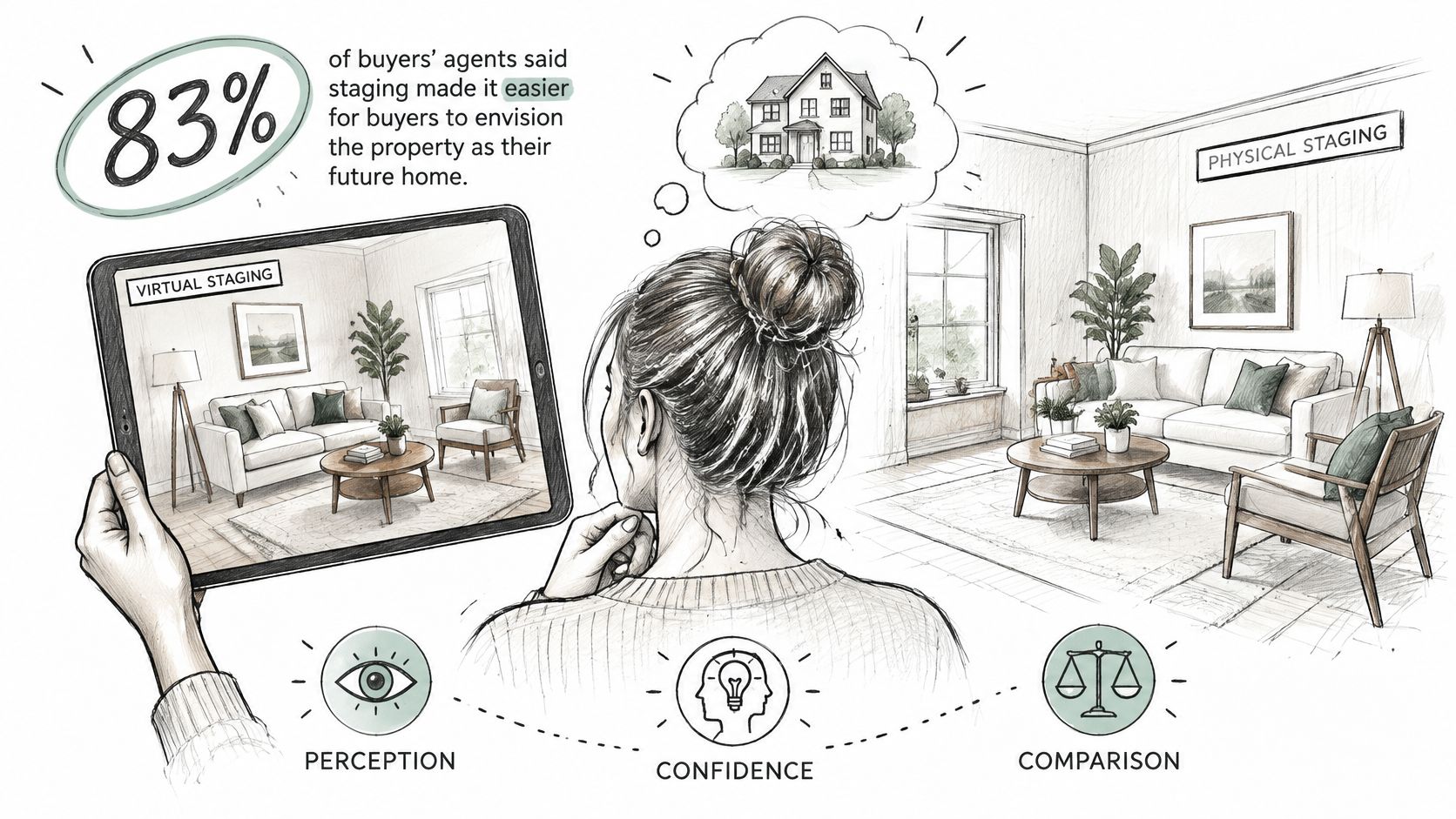
In NAR's staging survey, 83% of buyers' agents said staging made it easier for buyers to envision a property as their future home, according to the Florida Realtors summary of the findings. That finding concerns staging overall. It doesn't establish that adding digital furniture produces the same response as furnishing the property.
The first look establishes a possible use
At the photographic stage, buyers need to understand what they're seeing. An empty area beside a kitchen might accommodate dining, a workspace or neither comfortably. A carefully prepared furnishing image gives the buyer a proposed answer.
The useful outcome isn't just that the photograph looks warmer. It's that the buyer can identify the room's intended function without losing sight of doors, windows and circulation routes.
Physical staging can communicate that function through photographs too. Its additional value becomes apparent when the buyer arrives and finds the photographed arrangement still present.
A furnished photograph proposes how a room could work. A furnished room lets the buyer test that proposal.
The showing tests the interpretation
During a viewing, buyers compare the image with their own movement through the space. They can stand beside an actual dining table, assess chair clearance and see whether the seating arrangement obstructs a doorway.
A virtually staged property needs a different showing strategy. Give the agent the original and staged images together, so they can explain the proposed layout without implying the furniture exists. Where dimensions matter, provide measurements rather than asking the illustration to serve as a scale drawing.
This distinction also affects the offer conversation. A buyer may admire the styling yet remain uncertain about furniture fit, maintenance or finish quality. Neither staging method removes the need to answer those questions directly.
Judge online presentation and in-person confidence separately. Attractive photographs can make a property easier to interpret, but they don't prove that buyers will find the actual room equally convincing. When the image and viewing experience diverge, use buyer feedback to identify the unresolved concern instead of commissioning a more elaborate rendering.
Where Each Option Falls Short
Virtual staging can depict furniture, but it can't supply physical evidence of walkability, acoustics, surface reflectance or construction quality. Even apparent furniture scale needs verification against measurements rather than visual plausibility alone.
Say a narrow living room receives a digitally added sofa and coffee table. The composition may look balanced from the camera position while leaving insufficient clearance beside the seating. A buyer walking through the room will test the space in a way the photograph cannot.
Attractive edits can answer the wrong question
A rendered oak floor that looks richer than the existing finish isn't better furniture staging. It's a different representation of the property. Similarly, placing an accessory over a damaged area may produce a cleaner image while leaving the buyer's actual concern unresolved.
The Boston.com analysis of virtual staging notes that no independent study isolates virtual staging's effect on price or time on market. Treat claims of a fixed improvement cautiously, especially when a provider applies findings about staging generally to digital images alone.
That evidence gap changes how a listing team should evaluate the service. Track production turnaround, cost per approved image and revision burden separately from inquiries, showing requests and offers. Completing images efficiently is a production result, not proof of a sale-price benefit.
Physical staging has operational limits too
Physical staging requires access, installation and eventual removal. Delivery routes, lift bookings, doorway widths and protection for floors can constrain the furniture selection before aesthetics enter the discussion.
If the listing remains unsold, the seller may face rental extensions or a new staging proposal. Ask what happens when furniture needs replacing, a room's use changes or the property must be cleared before completion.
Practical test: Identify what the buyer needs to verify physically before deciding how much of the presentation can remain digital.
Inspect the property before commissioning either option:
- Room proportions: Measure walls, door swings and likely furniture clearances.
- Ceiling heights: Check slopes, bulkheads and low sections that a camera angle can obscure.
- Flooring: Record the actual material, condition and color.
- Showing light: Inspect glare and shadows at likely viewing times.
- Access constraints: Confirm delivery routes, occupancy restrictions and collection arrangements.
Physical staging demonstrates an arrangement, but it doesn't certify the property's quality. Buyers still need to inspect finishes and condition rather than infer them from expensive furniture.
Disclosure and Trust in Virtually Staged Photos
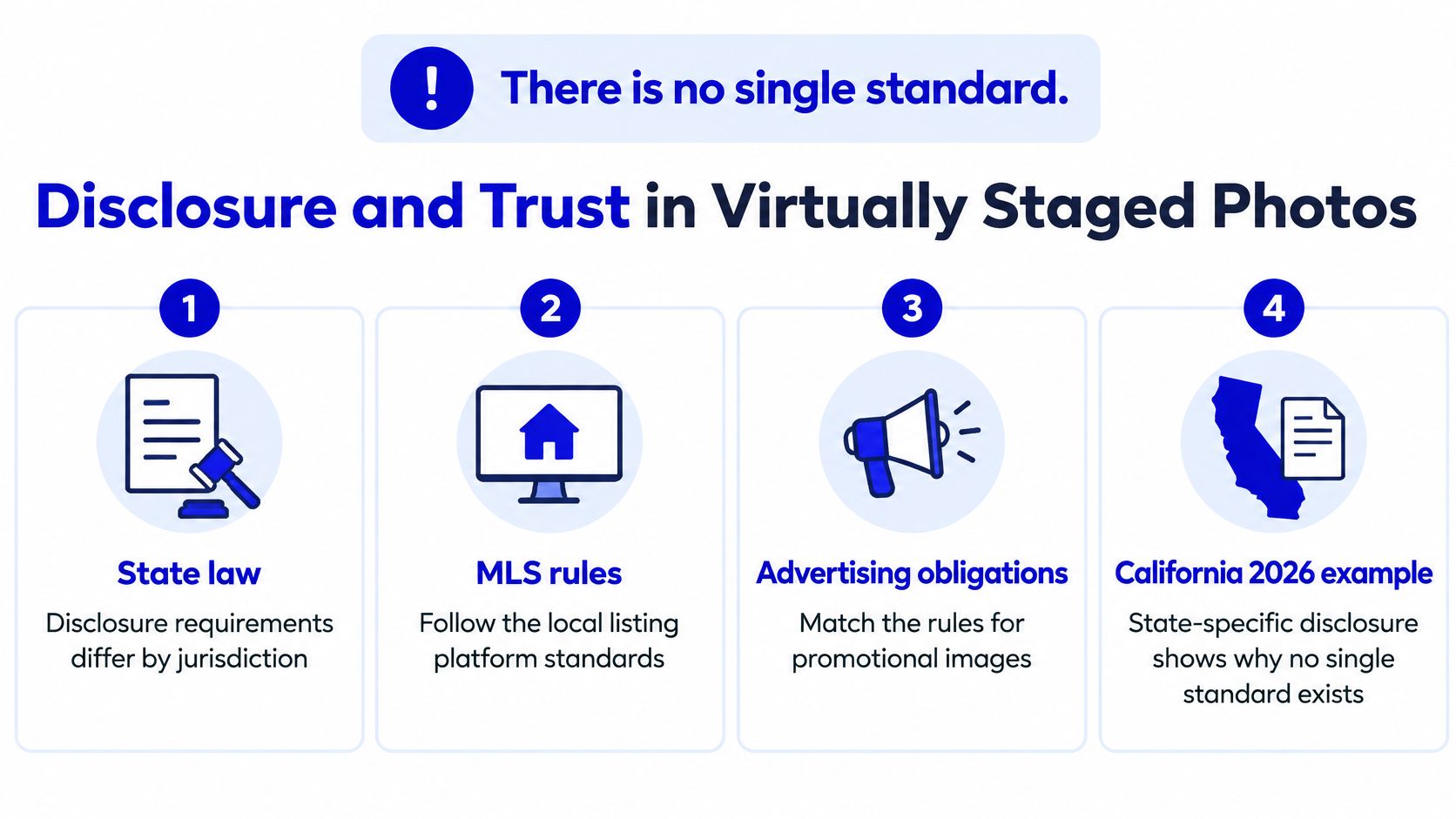
There's no single universal disclosure standard. State law, MLS rules and professional advertising obligations can apply together, and their requirements differ by jurisdiction. According to Bean Group's virtual-staging guidance, California's AB 723 requirements took effect in 2026 for covered advertising, including disclosure and access to the original image.
Describe the edit, not just the technology
A generic AI label doesn't explain whether someone added a sofa, replaced flooring or depicted a proposed renovation. Those edits carry different implications for a buyer deciding whether to arrange a viewing.
The distinction between photography and visualization is easier to manage when the team understands what photo rendering involves. Establish the permitted edit scope before production: movable furniture and decor are not permission to alter views, remove defects or invent permanent finishes.
Our outputs may not be presented misleadingly, including as an unedited photograph of an existing building or as a promise of how a planned building will look or comply with regulations. That boundary should guide image selection, not merely the small print added afterward.
Preserve a verifiable record
Keep the original photograph, edit description, timestamp and disclosure together. The practical aim is to let the listing agent reconstruct what changed and show the buyer the source image without searching through disconnected files.
StageHQ, our sister product, furnishes an empty room from a single photo for real estate agents and delivers it with the MLS disclosure badge. A supplied badge is a workflow feature, however, not a substitute for checking the applicable local requirements or the final portal display.
Use a publication checklist:
- Label every edited image: Apply the required wording and placement.
- Store the original: Keep an unedited, accessible copy linked to the final image.
- Log the change: Record furniture additions separately from any other image treatment.
- Inspect syndicated listings: Verify that portals retain the label and any required original-image access.
- Assign responsibility: Name the person who checks publication and corrects missing disclosures.
The cited guidance doesn't establish whether clear labels reduce click-through or showing requests. Responsibility when syndication strips a label also needs explicit agreement among the parties handling the listing. Trustworthy presentation means buyers can verify the difference between the property and the proposed furnishing scheme.
Which Listings Suit Each Staging Type
Best-fit staging by listing situation
| Listing situation | Better fit | Why |
|---|---|---|
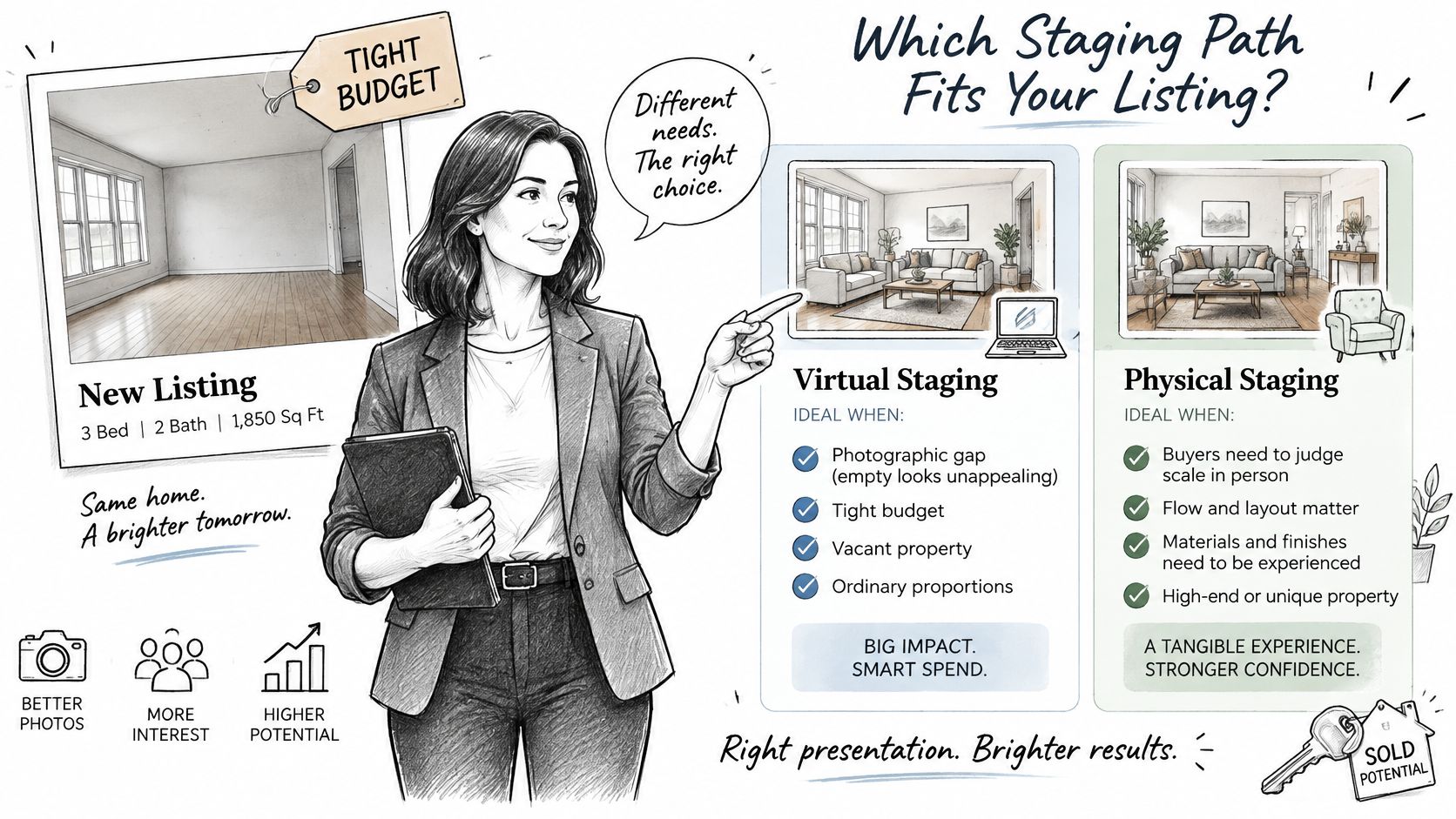
| Vacant home with standard room proportions | Virtual staging | The gap is photographic and no furniture needs to move |
| Empty room with unusual proportions | Physical staging | Buyers need to test scale and circulation |
| Luxury listing where materials carry value | Physical staging | Finishes, tactility and lighting need in-person assessment |
| Occupied home with clutter and mixed lighting | Physical staging after decluttering | Digital furniture may conflict with the actual presentation |
| Rapid visual test before a full staging spend | Virtual staging | Layout variants avoid repeated furniture moves |
| Listing where buyers must judge walkability or acoustics | Physical staging | An actual arrangement permits movement and listening tests |
The reversals follow a practical distinction: choose virtual staging when the missing information can be communicated clearly in a photograph. Choose physical staging when buyers need an actual arrangement to evaluate the room.
Online interest isn't the same as showing intent
In the NAR staging survey release, 31% of buyers' agents said buyers were more willing to walk through a home after seeing it online. This was a staging finding, not a measured virtual-staging conversion rate.
The implication is narrower than many sales pitches suggest. Better visualization can help buyers understand a listing without necessarily resolving the concerns that determine whether they visit. Price, location and the suitability of the actual property still require separate consideration.
Consider a hypothetical flat with a narrow living room photographed empty. Digital staging can show a plausible seating arrangement, but the key issue is whether a buyer can comfortably pass between that seating and the dining area.
A living-room staging guide can help develop the layout. Before publishing it, check furniture dimensions against the floor plan; if clearance remains the central objection, test an actual arrangement rather than generating a more flattering angle.
Allocate the budget to the difficult room
You don't need to make the same choice everywhere. A straightforward spare room may need only a clearly labeled furnishing image, while an awkward main living area merits physical staging.
For the physical portion, Miller Waldrop Furniture & Decor's rental tips provide useful context for planning furniture rental. Select pieces for demonstrable fit, not just their appearance in the catalogue.
Evaluate the listing using distinct measures:
- Online engagement: Do buyers examine the images and request further information?
- Showing requests: Does interest progress to scheduled visits?
- Offer quality: What conditions, objections and financing risks accompany offers?
- Seller cost and exposure: Record production, rental and carrying costs alongside time on market.
Compare similar property types while accounting for photography quality, asking price, location and vacancy. Otherwise, a well-priced vacant flat and an overpriced occupied house tell you little about which staging method worked better.
Confirm the Staging Choice Before You List
Choose virtual staging for a photographic presentation problem; choose physical staging when the buyer needs to test an arrangement. A vacant property with ordinary proportions and a constrained budget is a strong candidate for digital furnishing. A home whose appeal depends on difficult clearances, distinctive materials or occupied-room presentation needs a more tangible plan.
Make the decision before commissioning images
- Name the buyer's main question. Is the uncertainty about room use, furniture fit, finish quality or property condition? Write it plainly so the brief addresses a real objection.
- Match the property to the appropriate listing situation. Inspect the difficult spaces rather than choosing from attractive supplier examples alone.
- Collect comparable proposals. Request cost per approved image or a defined physical-staging package, along with revision terms and written turnaround commitments.
- Establish who retains the original photograph, records the edits and checks disclosure after publication. Confirm how buyers will access the original where required.
- Run a limited test when appropriate. Try digital furnishing in a representative room before extending the treatment across the listing or committing to a larger physical installation.
Preparation comes before either purchase. Repairing damaged paintwork or cleaning a tired surface changes what buyers inspect; editing the photograph doesn't. For practical preparation, you can find presale painting and decorating tips from Alex Trend Painters.
Approve against the property, not the image alone
Our Quick tools include Virtual Staging AI alongside Interior AI, Exterior AI, Masterplan AI, Render Enhancer, 8K Upscaler and Sketch to Image. For an existing-home listing, choose the workflow and edit scope that preserve an accurate account of what's for sale, rather than treating every design capability as an appropriate advertising edit.
Before release, compare the final image with the original and the room itself. Reject invented openings, altered finishes or implausible furniture dimensions, even when the result looks more attractive.
Final decision rule: Match the staging to what buyers will test in person, and match the disclosure to what you changed before anything goes live.
mnml.ai offers Virtual Staging AI and architectural visualization tools for developing furnished room images from existing visual material. Visit mnml.ai to test a furnishing approach for a suitable vacant room, then check the result against the original photograph, measured layout and local disclosure requirements before using it in a listing.